Friday, October 17, 2008

GENRE: Nonfiction and Biography


A biography...


http://images.google.com/images?hl=en&q=joan+of+arc+stanley&btnG=Search+Images&gbv=2


BIBLIOGRAPHY


Stanley, Diane. 1998. Joan of Arc. New York: Morrow Junior Books. ISBN: 0688143296.


PLOT SUMMARY


This book is a historical account of the life of Joan of Arc. The book takes the reader from Joan of Arc's childhood all the way to the moment of her death. Stanley recounts what is known and recorded of what France was going through during the 100 Year War and how that war shaped the life of a peasant girl who believing she was summoned by angels to intervene and make a difference in France she lived her life fulfilling the command of her visions. The events in the book are historically accurate and portray accurately the life of Joan of Arc.


CRITICAL ANALYSIS


Diane Stanley does a beautiful job in the biography of Joan of Arc. Stanley gives her readers a good foundation of the events that happened before, during and after the life of Joan of Arc by including at the beginning of the book the section titled "A Hundred Years of War." The author also includes a helpful and interesting pronunciation guide of the French words included in the biography along with a map of the areas travelled and mentioned throughout the book. At the end of the book Stanley also includes a bibliography and a list of books about Joan of Arc recommended for young readers. Stanley's book is a vivid and well-detailed biography on the life of Joan of Arc. At the end, the author makes a statement that sums up about the facts found in her biography. This is what Diane Stanley says:


"The transcripts of Joan's trial for heresy is much more than just the record of a judicial proceeding; it is the autobiography of Joan of Arc. Through her answers, in her own simple words, she gives us a first-person account of her childhood, her visions, and her extraordinary career."


Overall, the book does a wonderful job of relating the facts in a way that keeps young and old mesmerized with every word that recounts the life of a hero, Joan of Arc, and the pictures are beautiful and complement the story just right.


REVIEW EXCERPTS


Starred reviewed in Publishers Weekly. "Appealing to the audience's intelligence and imagination, this book stimulates an interest in both its particular subject, Joan of Arc, and history in general."


Reviewed in School Library Journal. "This narrative description of the greatest of French saints is a work of art, a good story, and a model of historical writing."


CONNECTIONS


This is a book has an interdisciplinary purpose in a classroom. It can serve as a literature work, a book to learn about history or a book to analyze and learn about art. It is a valuable tool in any classroom.


To learn more about the author, Diane Stanley, click on this link. Some other biographies written by Stanley are:


Saladin: Noble Prince of Islam

Michaelangelo


Peter the Great


Sibert Award winning book...


http://i.biblio.com/z/793/353/9780439353793.jpg


BIBLIOGRAPHY


Bartoletti, Susan Campbell. 2005. Hitler Youth: Growing Up in Hitler's Shadow. New York: Scholastic. ISBN: 0439353793.


SUMMARY PLOT


This nonfiction book tells the story of the children that found themselves in the middle of Hitler's movements and rise to supremacy in Germany. Hitlerjugend, Hitler Youth, was an organization formed by teenagers to serve and dedicate themselves to Hitler's ideology. Susan Campbell Bartoletti's book gives a gruesome and chilling picture of what it was to be growing up during the era of Hitler's rise and how he attracted so many young and susceptible minds to carryout atrocities against the Jewish people. The book tells of how some supporting parents, and others who were not, allowed their children to be drawn into these groups of children who were devoting their lives to Adolf Hitler. Unfortunately, these children became part of history by becoming part of Hitler's followers and following his orders. The book retells story after story of children's lives on how they followed or did not follow Hitler, how some of them destroyed their families for loyalty to Hitler, and how most of them risked their lives either by being on or against Hitler's side.


CRITICAL ANALYSIS


Campbell Bartoletti chronicles the lives of some of the children who found themselves in the middle of the Hitler turmoil. The events are retold in simple language that convey the message thoroughly and very vividly. Many personal stories are told such as the one of Hans Scholl. He was a young man attending the University of Munich in 1942. He and others were the founding members of the group called White Rose. They spoke out against Hitler and the atrocities being committed against Jews. With the use of a duplicating machine, Scholl and others courageously passed out leaflets of information in Munich and southern Germany.


Just like his story several others are told in Campbell Bartoletti's book. The book chronicles young lives that some were supporting Hitler and others were not. Not only the powerful words written by the author get to the readers, but also, the vivid pictures found throughout the book. No one that reads this book can forget the faces and emotions plastered all over the pictures. Such is the case of the picture found just right before the Foreword. It is of a young boy not older than six or seven years old in full Storm Trooper uniform with swastika and all doing the Nazi salute.


The sections at the end of the book do a great job in wrapping up all the facts in the book. The Epilogue tells the reader of what became of each young person met throughout the book. The time line of the events involving Hitler's youth make it easy for readers to put all the events together and understanding year-to-year the different things that happened that shaped the youth of that era in Germany.


Overall, this book is great for anyone to read and learn about the youngsters that found themselves in the middle of the historical events that led to and of World War II. The authors does a wonderful job of informing the readers of what happened during that time to some young people who decided to follow Adolf Hitler and some who decided to go against him. A much recommend book for young and old to read and learn and enjoy.


REVIEW EXCERPTS


Reviewed in Publishers Weekly. "Bartoletti's portrait of individuals within the Hitler Youth who failed to realize that they served "a mass murderer" is convincing, and while it does not excuse the atrocities, it certainly will allow readers to comprehend the circumstances that led to the formation of Hitler's youngest zealots."


Reviewed in Booklist. "The handsome book design, with black-and-white historical photos on every double-page spread, will draw in readers and help spark deep discussion, which will extend beyond the Holocaust curriculum. The extensive back matter is a part of the gripping narrative."


CONNECTIONS


This link takes you to the author's official site, Susan Campbell Bartoletti.


Another Siber Award book by Susan Campbell Bartoletti:


Black Potatoes: The Story of the Great Irish Famine 1845-1850


Nonfiction book by Seymour Simon


http://ecx.images-amazon.com/images/I/61GPG4CAGBL._SL500_AA240_.jpg

BIBLIOGRAPHY

Simon, Seymour. 1987. Animal Fact/Animal Fable. New York: Crown Publishers, Inc., a Random House Company. ISBN: 0517588463.

PLOT SUMMARY

This book gives a popular statement about a given animal and asks the reader to decide if it is a fact or fable about the animal. At the turn of the page, the reader will find out if indeed the statement is a fact or a fable about the animal. The reader not only will find out if it is a fact or a fable, the reader will learn about the basis of the statement given and learn the specific facts.

The illustrations in the book by Diane deGroat are wonderful in depicting the statement given about the animals in a humorous way. Again, at the turn of the page, the illustrations turn serious and educational. The illustrations certainly detail the content of the book in a very eloquent and entertaining way.

The reader will learn about different kinds of animals from domestic to wild animals. The book is full of fables, facts and facts about where the fables might have originated for each animal in the story.

CRITICAL ANALYSIS

This is a nonfiction book that will keep young readers entertained and educate them as they are reading. The book is designed in such a way that the reader can read a statement and try to decipher if it is fact or fiction. For example, most of us have heard that some bees sting only once which Seymour Simon explains that it is a fact. The author, in a very simplistic way, gives the facts behind this statement. Simon does it in such a way that the reader will close the book knowing the facts behind some fables known about some animals.

Also, the pictures are a great complement to the book. The pictures are done in a dual way. They literally depict the fact or fable for the statements given in the story.

It is a truly wonderful and recommended book for young readers to enjoy and learn at every turn of the page.

REVIEW EXCERPTS

Starred reviewed in School Library Association. "Combining instruction with amusement can be a tricky business, usually one aim is sacrificed to the other. Here is a book that manages a balance, and succeeds...A very fine collaboration."

Reviewed in Publishers Weekly. "Every entry is a surprise is the best kind of book-one that entertains while it educates."

CONNECTIONS

This is an excellent book to use to teach young children about fiction and facts about animals. The following link takes you to a website full of extension activities that go along with Seymour Simon's book:

http://www.macmillanmh.com/reading/2005/student/activity.php3?story=117

Wednesday, October 15, 2008

GENRE: Poetry


Book of poetry...


http://images.google.com/images?gbv=2&hl=en&q=come+sunday+grimes


BIBLIOGRAPHY


Grimes, Nikki. 1996. Come Sunday. Michigan: William B. Eerdmans Publishing Company. ISBN: 0802851088.


PLOT SUMMARY


The poems in this book take the reader through each facet of a typical Sunday of the main character, LaTasha. The first poem is of her mother waking her up Sunday morning to get ready for church. As the story keeps going, Nikki Grimes offers a poem for arriving at church and seeing the ladies of the congregation, the description of what the ladies are wearing, the walking-in of the ushers, the singing, baptisms, Sunday school, the offerings, supper at church, the preaching, the end of the day, and laying herself back to sleep. Each poem is from a little girl's point of view of how she perceives a Sunday and what happens at church. The poems take the reader from the beginning of Sunday to the end of the day.


CRITICAL ANALYSIS


Nikki Grimes does a beautiful job in narrating a Sunday at church through the use of poetry. Each poem is written in such a precise way that the reader gets a sense of being at church right next to LaTasha, the narrator of the poems. The language used is simple, but yet, so descriptive that when reading each line you can almost feel the laced gloves, you can almost taste the sweet glazed yams, you can feel the uncertainty of going in the water during baptism, and you can feel the strong faith of the LaTasha when she implores to him at times. The poems turn a typical day at church into an interesting, sweet and inspirational day through the descriptive words used by the author. It is a wonderful book of poetry that turns the mundane into celestial.


REVIEW EXCERPTS


Review in Booklist. "Grimes' short poems, boxed neatly into each ink-and-watercolor double-page spread, capture both the jubilation of a spirit-filled African American congregation and the more solemn moments. Yet both author and illustrator make sure that all this wonder is reflected strictly from the child's point of view."


Review in School Library Journal. "Grimes's topical poems are short and down-to-earth enough to engage children and occasionally will sweep them along with a bouncy rhythm or a spark of recognition that brings LaTasha's Sunday to life."


CONNECTIONS


This book is an excellent way to present children with well-written poetry. They are short but full of description. This book can be a wonderful tool in the classroom to also introduce descriptive writing and sequence of events, and there will be plenty of personal connections since the poems deal with a universal theme of religion and congregations.


Other books by Nikki Grimes are Oh, Brother! and The Road to Paris.


This is a link to Nikki Grimes website:


http://www.nikkigrimes.com/


A verse novel...


http://images.barnesandnoble.com/images/7380000/7382202.jpg


BIBLIOGRAPHY


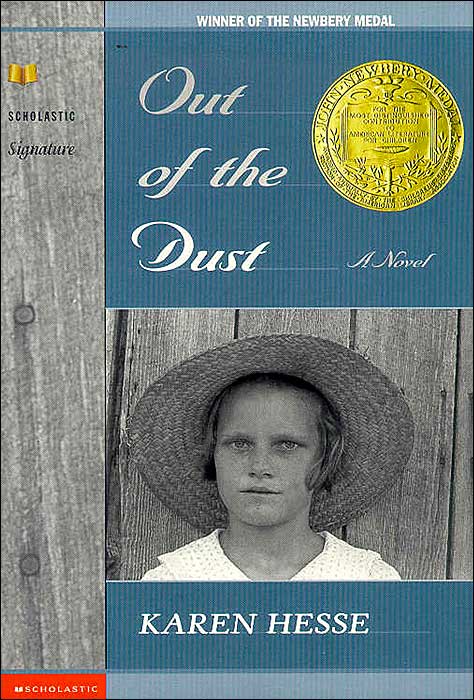
Hesse, Karen. 1997. Out of the Dust. New York: Scholastic Press. ISBN: 0590360809.


PLOT SUMMARY


Billie Joe. Dust storms. Things lost. Things gained. Karen Hesse writes the story of a young girl growing up during the hard times of the 1930s in a farm that does not cease to see dust storms. She lives with her stoic father and her determined, pregnant mother in a farm that is not yielding much for everyday leaving. Although much is happening that could kill the spirit, they keep going forward and making ends meet as much as they can. They are looking forward to the birth of the new baby, but unfortunately, a tragic accident eventually takes the life of the newborn baby and Billie Joe’s mother. Billie Joe blames herself of the events that took her mother and brother away, and deep down, she can’t forgive her father for inadvertently setting up the very thing that made the accident happen, a pail of kerosene next to the stove.

Not only does Billie Joe lose loved ones but also, she loses her ability to play the piano which is the one and only thing in which she resembles her mother. During the accident, Billie Joe burned her hands terribly. So much that she is unable to play the piano without feeling great pain. That pain leads for her to stop playing the piano which is the one thing she loves. Among the things lost, Billie Joe also copes with a strained relationship with her father.

After many tries of coping with all things lost and the dust storms, she decides to run from the dust and the pain. Later, she understands that getting out of the dust is futile because the dust is inside of her as she explains it to her father. It is an intense moment of revelation both for Billie Joe and her father, and at that moment, their relationship becomes stronger and more understanding.


As the story is coming to an end, Billie Joe’s father is courting a woman who is trying to understand what they have been through and is not trying to replace or step on no one’s toes. Little by little, Billie Joe starts to open the doors to her soul to this woman who is making things better at home. The novel ends with Billie Joe letting the reader know that things will be fine, and she will keep growing to be a stronger person next to her father and the new woman.


CRITICAL ANALYSIS


Karen Hesse touches the reader in an unbelievable way. The award-winning novel keeps the reader hooked through the intense rollercoaster ride of emotions and events. The reader is at the edge of the seat as each powerful event unfolds in the novel in which Billie Joel, the main character, takes us through her everyday life filled with hardships and life-learning moments. Hesse does a wonderful job of describing the emotions inside of Billie Joe which range from happiness to regret, from sadness to anger. In this novel, the reader learns about the hardships of the Great Depression, the difficult and intriguing life in an area of dust storms, family bonds and the “growing pains” of a young girl. The novel is beautifully written in verse-form, and it will surely leave the reader with a better understanding of life and family. This timeless novel is much recommended. No one that reads it will be unmoved by the canny way Hesse writes each verse in the novel that difficult to put down once it has been started.


REVIEWED EXCERPTS


Starred review in Publishers Weekly. "This intimate novel, written in stanza form, poetically conveys the heat, dust and wind of Oklahoma. With each meticulously arranged entry Hesse paints a vivid picture of her heroine's emotions."


Starred review in Booklist. "A powerfully compelling tale of a girl with enormous strength, courage and love."


CONNECTIONS

As this novel was being read, many connections were being made to what the present-day economy is going through here in the United States. This novel is a must read during anytime but more so during these difficult times that U.S. families are facing. In the classroom setting, many connections can be made in an interdisiciplanary setting. Students can learn about history, geography, science, literature, human spirit and so much more.


The following is a great link to use to learn about The Dust Bowl. It provides timelines, maps website links and images that are great, useful tools to teach students:


http://www.pbs.org/wgbh/amex/dustbowl/


A book of poems...


http://images.google.com/images?hl=en&q=a+pizza+the+size+of+the+sun&btnG=Search+Images&gbv=2


BIBLIOGRAPHY


Prelutsky, Jack. 1994. A Pizza the Size of the Sun. New York: Greenwillow Books. ISBN: 0688132359.


PLOT SUMMARY

This book is a compilation of funny poems. Some are long and some are short, but mostly, they all go to a rhyme. The topics vary from a crazy computer to a shy lettuce. The illustrations done by James Stevenson capture Prelutsky's poems with much precision. Such is the case of the poem "I'm Drifiting Through Negative Space" well depicted simply by a gray background in which the tone of the poem is negative and contrary. Overall, this book of poems is full of humor ready to be enjoyed, and the indexes at the end of the book come in handy in locating the poems in the book.


CRITICAL ANALYSIS

Jack Prelutsky along with James Stevenson can readily put a smile on someone's face with these silly and funny poems. It is a book that can be enjoyed and read time and time again. Poems can be read one at a time, or chunks at one time, or read all in one seating. They are meant for young and old and girls and boys. Prelutsky does a wonderful job of playing with words and silliness such as in "Llook!", a poem about llamas.

Being one that is usually not inclined to read poetry, I found myself picking up the book time and time again to read these poems. One quickly became a favorite because it remounted me to my childhood in which I often thought of inanimate objects having feeling and thoughts. That poem is "If." I have read it many times, and every time I find something new to understand and enjoy.

This book is recommened for easy-going reading that will lift the spirit and find a smile lurking as it is being read.


REVIEW EXCERPTS


Reviewed in Booklist. "The verse finds perfect visual expression in Stevenson's witty ink drawings touched with gray wash. A delightful addition to poetry collections that will not stay on the shelf for long."


Reviewed in School Library Journal. "Perfect for reading aloud or alone, it will be reached for again and again by teachers, parents, kids, librarians, and anyone else who likes poems that make them chuckle. As a matter of fact, this book should be required reading for those out there who claim they don't like poetry."


CONNECTIONS


SLJ's review hit right at home when they recommend the book to people who supposedly do not like poetry. I am one of those, and I can say I thoroughly enjoyed the book by Jack Prelutsky. I will give Prelutsky's other books a try, too, for sure.

The New Kid on the Block (starred reviewed)
Something BIG Has Been Here (starred reviewed)
My Parents Think I'm Sleeping

Tuesday, September 30, 2008

GENRE: Traditional Literature


A Version of Cinderella...


http://images.google.com/imgres?imgurl=http://i14.ebayimg.com/01/c/02/00/1f/15_8.JPG&imgrefurl=http://product.ebay.com/Bubba-the-Cowboy-Prince_ISBN-10_0590255061_ISBN-13_9780590255066_W0QQfvcsZ1388QQsoprZ832685&h=251&w=304&sz=17&hl=en&start=4&sig2=4aIIabsYVZu3JXPWjXApkw&um=1&usg=__3KbkfRRxClvFHW1SmZ_tyorZ340=&tbnid=7FDxtfyU8XkRCM:&tbnh=96&tbnw=116&ei=szLkSI6nJIGy8AT35NmzDg&prev=/images%3Fq%3Dbubba%2Bthe%2Bcowboy%26um%3D1%26hl%3Den%26sa%3DG


BIBLIOGRAPHY


Ketteman, Helen. 1997. Bubba The Cowboy Prince A Fractured Texas Tale. New York: Scholastic Press. ISBN 0-590-25506-1.


PLOT SUMMARY


Bubba, the main character, is a cowboy in Texas living with his wicked stepdad and mean stepbrothers. They try to make his life miserable by making him do all the chores around the ranch. Bubba loves ranching, so he does not mind doing the work. One good day Miz Lurleen, the richest and prettiest girl around, decides to throw a ball to find herself a husband. Since Bubba did not have appropriate attire, he does not go to the ball. That is, till, a fairy godcow appears to help him get ready for the ball. Once at the ball, Bubba and Miz Lurleen dance and start liking each other. At midnight, Bubba's attire and fetid smell come back. He dashes out of the ball losing one of his dirty boots while Miz Lurleen calls after him. Determined to find the owner of the boot, Miz Lurleen takes on the task of having the men in the county try on the boot. Bubba and the boot are a perfect match such as Bubba and Miz Lurleen are, too. Happily, they ride off into the sunset as the wicked stepdad and stepbrothers throw a chicken fit.


CRITICAL ANALYSIS


Helen Ketteman has created a very enjoyable fractured tale based on Cinderella. As the story is told in a Texan slang, the author captivates her audience by making the tale hilarious and extremely entertaining. Although the reader might know somewhat what will happen at every turn of the page, it does not take away from the story, and on the other hand, the reader is eager to know what twist will be added to this "Cinderella" story. It is not difficult at all to get into the story and the Texas twang right away. If it is being read aloud, the reader will soon find himself or herself reading the story Texas-style. It is a wonderful fractured tale that makes it extremely amusing to whoever reads the story.


REVIEW EXCERPTS

Review by Booklist. "With a male in the starring role, this charming and funny retelling may hold more appeal for young boys than the traditional version may."

Review by Publishers Weekly. "Rustler lingo and illustrations chockablock with Texas kitsch make this ranch-spun Cinder-fella a knee-slappin' tale."


CONNECTIONS

This wonderfully told story can serve as a springboard for many activities for young children. Teachers, as well as parents, can compare and contrast the story with the traditional tale of Cinderella. Also, the genre of fractured tales can be explored and analyzed. In the classroom setting, a poll can be taken to see which version, fractured fairy tale or traditional tales, is more popular with the children.


This link will provide further information about the author, Helen Ketteman: http://biography.jrank.org/pages/2073/Ketteman-Helen-1945.html


Folk Literature Collection...


http://images.google.com/images?hl=en&q=and+the+green+grass+grew+all+around&btnG=Search+Images&gbv=2


BIBLIOGRAPHY


Schwartz, Alvin. 1992. And the Green Grass Grew All Around. USA: HarperTrophy A Division of HarperCollins Publishers. ISBN: 0064462145.


PLOT SUMMARY


This book is full of rhyme and folk poetry. The book is divided into sections that depict a given theme for the poetry found in that part of the book. There are folk poems that range from food or school to nonsense or rain and shine. The author does a beautiful job of compiling and organizing all these poems that bring to life everyday basic and silly things. The book starts with an introduction by the author where first days of school are described to latter life moments in which folk tale was understood and researched. After the introduction, a great selection of poetry is found. At the end of the book, a section of notes, sources, bibliography and index of first lines can be found about the content of the book.


CRITICAL ANALYSIS


This book is one that can be enjoyed by opening to any page in the book. The rhymes are silly and take the reader back to childhood times. It would be unusual for the reader not to find at least one poem that has been heard before. Although some poems or rhymes might not be politically correct in our times, they do possess a lesson in life that can be taken by anyone reading these rhymes. The book is written in a simple way that attracts the reader to keep on reading every line. The illustration are also simple and not overpowering that take away from what is being read. Overall, the book is recommended for some fun and easygoing reading.


REVIEW EXCERPTS


Starred reviewed in Booklist. "The late Alvin Schwartz has left a joyful legacy in this collection of folk poetry for everyone to share."


Reviewed in School Library Journal. "A marvelous book that is sure to become a classic if children have any say in the matter."


CONNECTIONS


These are other books written by Alvin Schwartz (1927-1992). Most of his books are based on the theme of folklore and wordplay:


Stories to Tell a Cat
And the Green Grass Grew All around: Folk Poetry from Everyone
Gold and Silver, Silver and Gold: Tales of Hidden Treasure
I Saw You in the Bathtub and Other Folk Rhymes
Telling Fortunes: Love Magic, Dream Signs, and Other Ways to Learn the Future
Love Magic: Dream Signs and Other Ways to Learn the Future

Scary Stories to Tell in the Dark
More Scary Stories to Tell in the Dark Scary


A retold folktale...


http://images.google.com/images?hl=en&q=tony%27s+bread&btnG=Search+Images&gbv=2

BIBLIOGRAPHY

dePaola, Tomie. 1989. Tony's Bread An Italian Folktale. New York: G. P. Putnam's Sons. ISBN: 0399216936.

PLOT SUMMARY

Tomie dePaola’s retold folktale revolves around three main characters. There is Tony, a baker that lives in a small town in Italy, his beloved daughter, Serafina, and Angelo, a clever nobleman from Milano. As the story is told, the reader finds out that Tony’s dream is to establish a bakery in Milano and that he spoils his daughter by giving her everything she wants. Tony adores his daughter and believes no man is worthy of being with her. One day, Angelo is in town and falls in love with Serafina. By talking to Serafina’s aunts, he knows exactly how to get around Tony’s firm decision of not allowing any man to court his daughter.

Angelo offers Tony to take him and Serafina to Milano knowing it would be hard for Tony to refuse since Angelo is well aware of Tony’s dream. Needless to say, they all go to Milano and enjoy all sorts of pastries made by bakers in the city. After the trip, Tony feels much disillusioned thinking his baking will never compare to Milano’s bakers. Angelo does not give up on his idea of marrying Serafina, so they all brainstorm on ideas of baking wonderful bread. Once Tony knows what bread he wants to create, Angelo gives him the best ingredients for his new invention. The new bread becomes popular in Milano which paves the road for Tony and Serafina to move to Milano. As Serafina and Angelo marry in a quiet ceremony, Tony is being celebrated and acclaimed for the delicious bread he makes. The people call out “pan de Tonio” which brings about the name panettone for the wonderful bread know enjoyed by so many, especially during Christmas time.

CRITICAL ANALYSIS

Tony’s Bread is a charming folktale that explains how the Italian bread, panettone, came to be about. In his usual style of retelling stories and illustrating them, Tomie dePaola has created a wonderful book in which he takes the reader through events that lead to making the panettone. By retelling the story, dePaola also, allows the reader to learn a little about the Italian culture by the way the father is so protective of his daughter and the tight-knit aunts who gossip in low voices and help out in the unfolding of events in the story. It is a wonderful told story which can be enjoyed by young and old alike!

REVIEW EXCERPTS

Review in Publishers Weekly. "The tale is a typically charming dePaolian effort, and the illustrations abound with his trademark coziness."

Review in Booklist. "Lighthearted pictures in the artist's familiar style back the text, which heartily celebrates the setting with a liberal sprinkling of Italian phrases and such characters as the three meddling aunties."

CONNECTIONS

This link take you directly to Tomie dePaola's official website:

http://www.tomie.com/

dePaola has written and/or illustrated over 200 books for children. This is what he says about illustrating a book:

"If my book is going to take place in a different place like Mexico or Italy, I'll look at dozens and dozens of photos of those places to "exercise" my imagination. Sometimes, but not too often, I will do VERY rough sketches of the whole book in the DUMMY." (This excerpt was taken from Mr. dePaola's offical website).

Some of his most famous books that keep circulating incessantly through my library are:

Strega Nona

The Legend of the Bluebonnet

and my all-time favorite

Now One Foot, Now the Other

Tuesday, September 16, 2008

GENRE: Picture Books

A Cladecott Medal winner...


Google. Images. http://images.google.com/images?hl=en&q=hugo+cabret+pictures&um=1&ie=UTF-8&sa=X&oi=image_result_group&resnum=1&ct=title (accessed September 16, 2008).


BIBLIOGRAPHY


Selznick, Brian. 2007. The Invention of Hugo Cabret. New York: Scholastic Press. ISBN 0439813786


PLOT SUMMARY


Brian Selznick writes the story through the point of view of an orphan, Hugo Cabret, living in a Paris train station in 1931. Hugo finds himself in the middle of a mystery that involves his dead father, an automaton, a toy booth owner and his goddaughter, and a heart-shaped key that can unlock the mysterious wonder of the automaton. By following and deciphering clues, Hugo unveils events that will change his life and the life of others forever.


CRITICAL ANALYSIS


Selznick's writing is powerful and insightful. The reader, through his words, is able to transport himself to the main character's era and is able to feel the uncertainty, the wonder and amazement that Hugo feels. Hugo Cabret discovers new "talents" and feelings as the story progresses, and the reader does the same thing through his eyes and thoughts. The writer combines very eloquently fact and fiction by allowing the reader to learn about the birth of the motion picture era while living a fictional adventure through Hugo Cabret. As Hugo turns the pages of a reference book while trying to solve a mystery, the reader learns that "Georges Melies began his career as a magician and he owned a theater of magic in Paris." Selznick weaves fact and fiction magically in his novel.


Selznick's amazing story does not stop at words. He's story transcends words to the magical pictures he created for the novel. He drew the pictures using pencil on Fabriano Artistico watercolor paper. Even when no color is present, all pictures are black and white, the reader misses nothing and gains a lot from the detail picture that come to life as the pages are turned. Selznick is successful in telling the story through his pictures. When the words stop telling the story, the pictures continue to do so very seamlessly. The details of every drawing tell the emotions of the characters and events of the story so eloquently. When looking at Hugo's eyes on the drawings, the reader can almost wage that he is seeing the eyes of a living child. Selznick proves that a picture is worth a thousand words.


Personally, the novel was enthralling and captivating. I had a difficult time putting down the book once I started it. I read every word and admired every picture telling me the story. I wanted to know more and more about Hugo and all the characters that surrounded him. As the story unfolded, I could see that terrible, along with wonderful, events where at every turn of the story. I enjoyed the sections where the story was told through the pictures. I devoured every detail so as not to miss any clues that would take me to understand what Hugo was going through and discovering. In my opinion, the downfall of the book was that it had to end. I wanted it to keep going and keep living through Hugo.


It is a wonderful book in which I kept making connections with other masterpieces such as the Harry Potter series. In a very simple way, but yet very palpable way, Hugo and Harry seem to be alike. Both of them orphans and unveiling mysteries surrounding them make them alike, but of course, both in their own unique way as done by their creators. The Invention of Hugo Cabret is a novel that can be enjoyed by young and old and those that love mysterious adventures coupled with beautiful pictures that tell a story through every detail.


REVIEW EXCERPTS


Starred review in The Horn Book: "Complete genius."


Starred review in School Library Journal: "Shatters conventions."


CONNECTIONS


Some more books illustrated by Brian Selznick are The Dinosaurs of Waterhouse Hawkins which is a Caldecott Honor book, Walt Whitman: Words for America which is a New York Times Best Illustrated, and When Marian Sang which is a Sibert Honor winner.


A book and website that give more information about George Melies are Before Hollywood: From Shadow Play to the Silver Screen and http://www.missinglinkclassichorror.co.uk/index.htm.


About the creation of children's picture books...


Google. Images. http://images.google.com/images?um=1&hl=en&q=side+by+side+five+favorite+picture-book+teams&btnG=Search+Images (accessed September 15, 2008)


BIBLIOGRAPHY


Marcus, Leonard S. 2001. Side by Side Five Favorite Picture-Book Teams Go to Work. New York: Walker Publishing Company, Inc. ISBN 0802787789


PLOT SUMMARY


Leonard Marcus writes about five teams of collaborators who created timeless children's books. In his own easygoing style, Marcus reveals the stories of these collaborators that allow the readers to learn how teamwork played an important role in the creation of such books as Louis the Fish, Sam and the Tigers, The Stinky Cheese Man and Other Fairly Stupid Tales, The Magic School Bus Explores the Senses and The Glorious Flight. The writers is successful in entertaining while educating its audience about the roots of each book and how the collaborators were able to support each other while still giving space for a personal touch.


CRITICAL ANALYSIS


The author, Leonard Marcus, takes into the lives and thoughts of five teams of children's books collaborators. He manages to tell the readers how each book came to live in terms of the story line and the illustrations. The readers find themselves looking at early sketches of the books as well as handwritten editing by the hand of the authors. Marcus does a stupendous job in narrating the sometimes funny ways in which this collaborators came to work together. This being the case of Arthur Yorinks and Richard Egielski in which one recognized the other as a person being recommended by a professor to illustrate his stories. In terms of Joanna Cole and Bruce Degen, Joanna was intrigued about illustrating a science-related book that would be written, by Degen, in a lighter approach from the norm of nonficiton books. And just like that, Marcus' book continues to tell unusual anecdotes about these collaborators of children's books.


By the time the reader realizes it, the book has been completed with much entertainment and great facts about how great authors and illustrators have worked together to give their audiences unforgettable books. The pictures in the book give great insight as to what the collaborators were trying to convey to their audiences. The book includes pictures of authors and illustrators, covers of the famous books, copies of notebook papers with handwritten notes, and even some pictures of where the collaborators' homes. Overall, it is a great book that gets into the minds of the collaborators and lets the readers be part of that world that sometimes the public sees as unimaginable such as the world of writers.


This is a great book to share with children since it will give them the notion of how writers and illustrators work together to create stories and pictures that become timeless. Also, it gives them an insight of how the writing and illustrating process is something that takes time, and it is perfected as the work starts taking shape. Although it can be a great book for older children, the vocabulary is not simple enough for younger audiences. It can be shared with them, but it cannot be independent reading material for them.


As a school librarian, I do feel it is a "must see" for teachers, so they can learn and share the wonderful process of writing and illustrating a book with their students.


REVIEW EXCERPTS


Starred review in Publishers Weekly "Insights into the inner workings of bookmaking."


Starred review in Booklist "Inviting . . . well-written and beautifully designed."


CONNECTIONS


Other books by Leonard S. Marcus are A Caldecott Celebration which also received starred reviews, 75 Years of Children's Book Week Posters, and Author Talk.


The link to Marcus S. Leonard's website: http://www.leonardmarcus.com/index.html


A children's book illustrated by Betsy Lewin...


Google. Images. http://images.google.com/images?um=1&hl=en&q=duck+for+president (accessed September 15, 2008)

BIBLIOGRAPHY

Cronin, Doreen. 2004. Duck for President. Illustrated by Betsy Lewin. New York: Scholastic, Inc. ISBN 0439671442.

PLOT SUMMARY

Cronin’s story is an entertaining narration of an unhappy Duck with his duties at Farmer Brown’s farm. He decides to have an election to see who will run the farm. Of course, Duck wins and quickly realizes running the farm is no easy chore. In search of an easier job, he runs for governor and then for president winning both elections. Again, he comes to the crude realization that holding those offices is no easy task. As he checked the help-wanted ads, he sees a duck is needed at the farm. Duck goes back to the farm, but Farmer Brown is still running the farm (which is not an easy job) while Duck is busy writing his autobiography. Of course, the first line of his autobiography reads “Running a farm is very hard work.”

CRITICAL ANALYSIS

The comical tone of the book written by Doreen Cronin is well supported by the illustrator Betsy Lewin. The funny and detailed pictures done in brush and watercolor give the story the right touch to convey the feelings of the characters. The frustration, desolation, disdain, surprise, or contentness, among other feelings, felt by the characters can repeatedly be seen and felt throughout the storyline and pictures. Lewin does a very good job in capturing the feeling of the story along with the funniness. The story is enjoyable and the humorous pictures make it much more so for the readers.

A weakness of the story is tha the voting process is very basic, and many aspects of it are left out. The reader of the story will understand about majority votes but not the authentic and intricate process of voting. Even though the book deals much with elections and voting, I think the underlying message of the story goes back to "the grass isn't always greener on the other side." After going through three elections, Duck finally realizes this lesson. Duck for President is a great children's book that can easily be just enjoyed or analyzed for deeper meaning.

REVIEW EXCERPTS

Review in School Library Journal "Betsy Lewin's comical watercolors with bold black outlines come to life in this fully animated production."

Review in Library Media Collection "...clever, humorous story...full of puns..."

CONNECTIONS

Other books illustrated by Betsy Lewin:

Click, Clack, Moo; Cows That Type
Giggle, Giggle, Quack, Quack

Click Clack, Quackity-Quack

Sunday, August 31, 2008

A little about me...

Hello everyone! Thank you for stopping and looking at the book reviews I will be doing. My name is Saida Sanchez, and I am a librarian for an elementary school that serves students in Pre K to fifth grade. Before becoming a librarian, I was a teacher for 13 years. I have worked with students from first grade all the way to eighth grade. I have always loved reading, and I hope that by reading the reviews I will post you will feel motivated to go grab a book and enjoy it yourself. If you don't, at least, you will know a little more about the books and you can recommend them to someone else. Happy readings and hope to see you back.